The Designs
Three original designs, each inspired by a defining element of Savannah’s identity. Every piece tells a part of the city’s story.

The Oak
No image is more synonymous with Savannah than the live oak. Quercus virginiana— the Southern live oak — is an evergreen species that can live for centuries, its massive horizontal branches spreading outward in dramatic canopies that can span over a hundred feet. In Savannah, these ancient trees are draped in curtains of Spanish moss, creating the ethereal, almost otherworldly atmosphere that defines the city’s visual identity.
The live oaks of Savannah’s twenty-two squares are living monuments. Some are estimated to be over three hundred years old — older than the city itself. They shade the squares that Oglethorpe laid out, their branches intertwining overhead to form green cathedrals of filtered light. Walking beneath them is a fundamentally Savannah experience: the dappled sunlight, the gentle sway of moss, the sense of being held by something ancient and enduring.
Our Oak design draws from the tradition of botanical illustration — a detailed, reverent rendering of a single live oak, its branches spreading wide, its moss trailing in the still air. It is our tribute to the natural soul of Savannah, the living thing that gives the city its most distinctive silhouette.
The Oak is Savannah at its most timeless.
The Coordinates
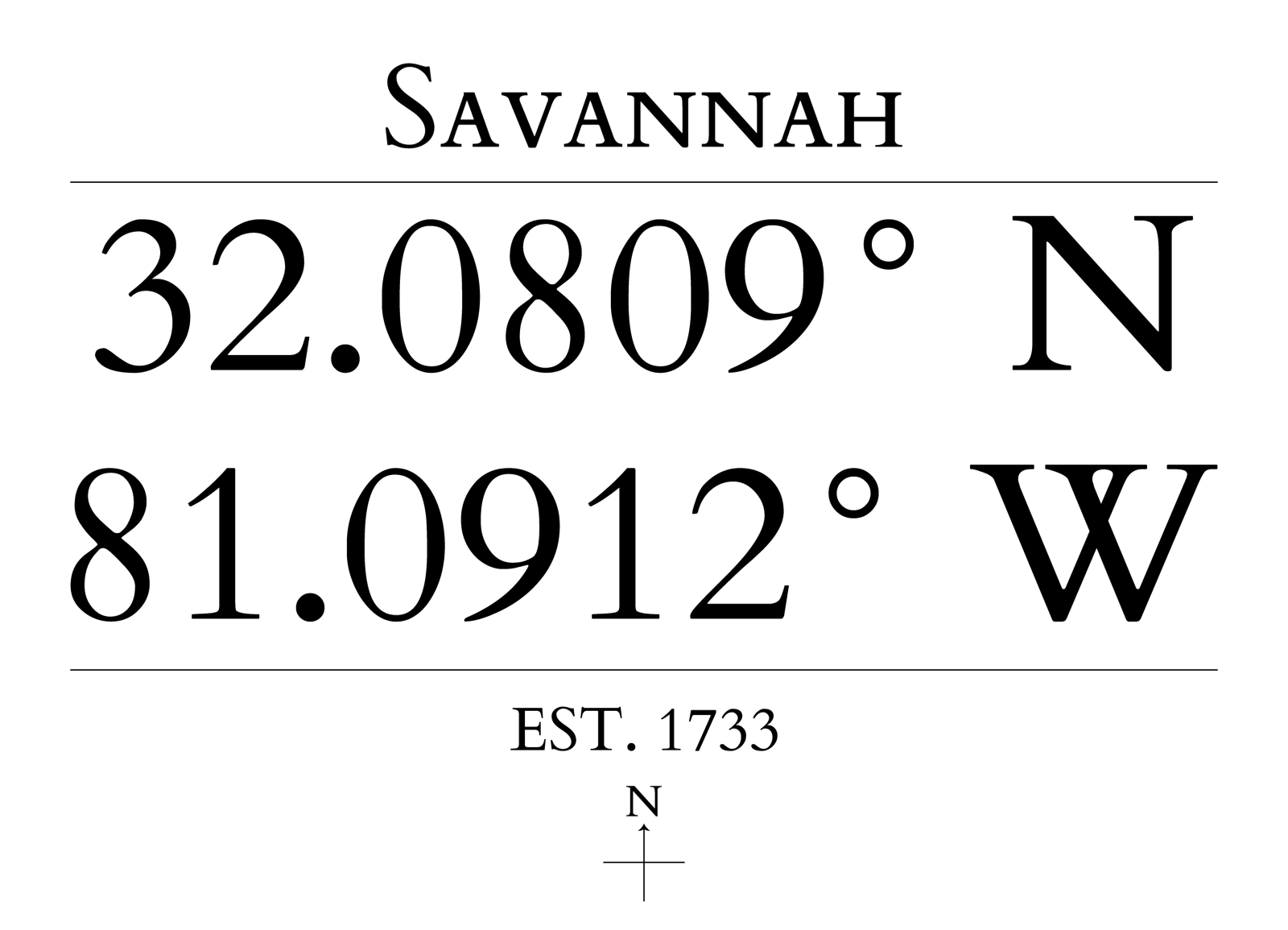
There is something powerful about reducing a place to its exact position on the globe. 32.0809° N, 81.0912° W. Those numbers are a kind of code — meaningless to most of the world, but instantly significant to anyone who has stood in that particular spot on the earth’s surface, who has walked those streets, who has felt the city settle into their bones.
Coordinates as design are inherently modern. They borrow the visual language of navigation instruments, passport stamps, and engraved brass plates — objects that carry a sense of precision, intention, and permanence. Our Coordinates design uses clean typography and generous negative space to present Savannah’s GPS coordinates as a statement of identity: this is the place that matters to me.
The aesthetic is deliberately restrained. No embellishment, no illustration — just the numbers themselves, set in a way that feels both contemporary and timeless. It is a design for people who prefer to let the meaning speak quietly, who know that the simplest mark is often the most personal.
The Coordinates is Savannah distilled to its essence.
The Grid
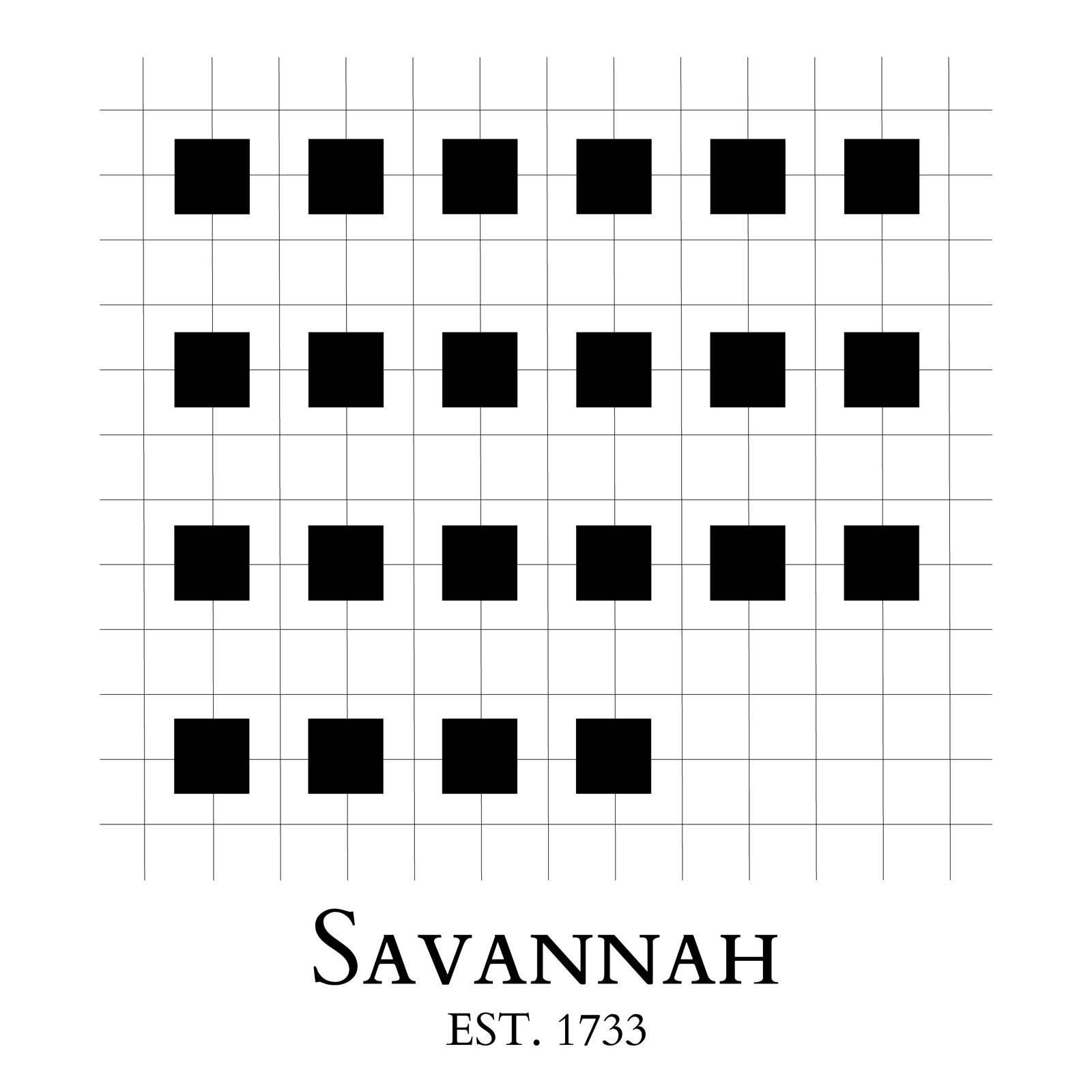
When James Edward Oglethorpe designed Savannah in 1733, he created something that urban planners still study nearly three centuries later. His plan was radical in its simplicity: the city would be organized into repeating units called wards, and at the center of each ward would be an open public square. Streets would run in a regular grid, but the squares would interrupt that grid at rhythmic intervals — creating pockets of shade, rest, and gathering throughout the city.
Twenty-two squares were eventually built, and they became the defining feature of Savannah’s urban landscape. The system was democratic by design: every resident, regardless of wealth, would live within steps of a public green space. The wards created natural neighborhoods. The grid created order without monotony. It was a plan that balanced structure with openness, efficiency with beauty.
Our Grid design is an abstraction of Oglethorpe’s original plan — a geometric pattern that echoes the ward system, with the public squares marked as focal points within the grid. It celebrates the idea that a city can be both rational and humane, that infrastructure can be art, that the most enduring designs are often the most elegant.
The Grid is Savannah as Oglethorpe imagined it.